


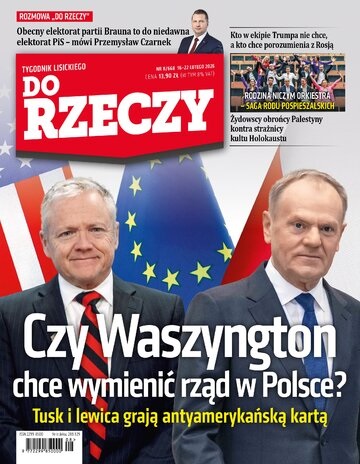
S zkola Oczerniania Polakow, by Piotr Gontarczyk. 2026. DO RZECZY 8(2026)668, 56-59
Phony August Decree Trials. Move Over, Grabowski and Engelking. Dariusz Libionka Falsehoods
Author Piotr Gontarczyk is a historian with the IPN who has spent much time debunking Holocaust-related attacks on Poland. This well-titled Polish-language article, THE SCHOOL FOR DEFAMING POLES, addresses more of the lies of the so-called Polish School of Holocaust Research. (Translations by DeepL). It focuses on the Dariusz Libionka falsehoods. For background information on the long history of such Holocaust-related falsehoods, see:
DARIUSZ LIBIONKA FALSEHOODS: ANOTHER FAKE POGROM–AT DZIALOSZYCE
In the media-touted anti-Polish book, NIGHT WITHOUT END, Dariusz Libionka brings up an alleged pogrom at Dzialoszyce in November 1918, which was only 23 years before the German-made Holocaust. Note, first of all, that this is a common Jewish trick: Drag-in something that long preceded the Holocaust in order to make the Poles look as bad as the Germans. Another Jewish trick is to take an ordinary civil disturbance, which targeted both Jews and goys, and make out of it an anti-Jewish pogrom.
Gontarczyk refutes the latter, “Chaim Schwimmer described the situation in the same way in the Jewish Yitzkor Book: “In the Kielce region, gangs were organized to attack landowners and their estates, rob people on the roads, and sometimes even kill them. Many people, both Jews and non-Jews, fell victim to these gangs. In our area, people even knew the leaders of these robbers.”…Libionka’s story about the pogrom of Jews at the dawn of Polish independence turned out to be a hoax.” (pp. 56-57).
DARIUSZ LIBIONKA FALSEHOODS. AUGUST TRIALS: ANONYMOUS ACCUSERS–A TRAVESTY OF JUSTICE
The Communist-era trials of “Polish collaborators” are nowadays dug up in order to re-victimize the Poles by making them “complicit in the Holocaust”. With regards to these August Decree Trials, Gontarczyk cites, “Even absurd anonymous reports are a major source of information about alleged crimes committed against Jews by Poles.” (p. 59).
Anonymous accusers! This alone makes the August Trials a farce of justice, and a totally unreliable source of information about “Polish complicity in the Holocaust”. After all, the right to confront one’s accuser is a basic human right guaranteed, for example, by the Sixth Amendment to the U. S. Constitution. Nearly all other nations have followed suit, with only a few narrowly-tailored exceptions based on extraordinary evidence supporting a policy of secret accusation.
DARIUSZ LIBIONKA FALSEHOODS. AUGUST TRIALS: FRIVOLOUS ACCUSATIONS ACCEPTED AS FACTUAL
Historian Gontarczyk highlights the bogus accusations in these trials, “…denouncing and killing Jews were in fact the result of personal vendettas and false accusations. After the war, these became a real plague, especially in the Polish provinces. The followers of the aforementioned research school [so-called Polish Center for Holocaust Research] do not accept these acquittals and dismissals, applying the principle not even of presumption, but of certainty of guilt. Accusations that turned out to be mere revenge for a beating at a party or for plowing 10 cm into someone else’s field, and even absurd anonymous reports, constitute a large-scale source of information about alleged crimes committed against Jews by Poles.” (p. 58).
DARIUSZ LIBIONKA FALSEHOODS. AUGUST TRIALS: “NOT GUILTY” VERDICTS DISREGARDED! BLAME POLES AT ALL COSTS
But wait. It gets even better. It turns out that accusations against Poles which the August trials had rejected are nevertheless accepted as factual by today’s so-called Holocaust scholars. Talk about special pleading!
Gontarczyk describes one such case, “Take Stefan Robak, for example, who was supposed to betray a group of Jews hiding in the area: ‘The victims were taken to Działoszyce or Drożejowice and shot. One wounded man was finished off the next day. The informer, Stefan Robak, received a pair of shoes belonging to one of the victims as a reward; as it later turned out, there were dollars hidden in them’. (p. 151). As evidence to confirm this version of events, the author provided a footnote: ‘Protocol of Robak’s interrogation, January 28, 1949.’ During the interrogation, Stefan Robak testified: ‘I did not help capture Jewish citizens during their escape during the German occupation…(original spelling, AIPN Ki 127/328). Robak denied the allegations, did not receive any shoes as a reward for participating in the roundup, and the court acquitted him of the charges of participating in the roundup, which he had already noticed while it was in progress.” (p. 58).
Notice the two-facedness. The Holocaustians (notably Andrew Kornbluth) insist that the verdicts handed down by the August Trials are reliable. That is, except when they do not support Jewish attacks on Poland, at which time they suddenly are not. How convenient!
BLAMING POLES FOR GERMAN AND JEWISH CRIMES–AGAIN
Dariusz Libionka focuses on the alleged roundup of Jews by Poles at Dzialoszyce. This is cherry-picking of historical sources with a vengeance. See my review of the Jewish eyewitness to the massive and decisive Jewish-Nazi collaboration:
https://www.jewsandpolesdatabase.org/2019/11/04/jewish-collaboration-expansive-wolgelernter/
Historian Gontarczyk evaluates this Jewish eyewitness, “Wolgelertner stated that Gestapo officers, assisted by Jewish policemen, searched Jewish homes. The former killed those who were unable to leave their homes. However, in ‘Dalej jest noc’ [NIGHT WITHOUT END] (as usual), Dariusz Libionka omitted information about the role of the Jewish police and then attributed the actions of the Nazis to the Polish police rather than the Germans, including the murder of Rabbi Staszewski…it is worth adding that the author used similar methods to attribute responsibility for the death of Rabbi Lejb Seidmann from Skała to the Poles.” (p. 74). (p. 58).
THE (POLISH) TAIL WAGS THE (GERMAN) DOG
Shifting the blame from Germans to Poles can also be subtle, as by cropping out the German order-givers and monstrously-enlarging the few mostly-coerced Poles. Gontarczyk writes, “In another part of the text, the author discusses the German crime near Słomniki: ‘Between 120 and 150 men, women, and children were murdered in the Niedźwiecki Forest…But Libionka changed the course of events, removing from the story the key role and names of two German military police officers – the organizers and perpetrators of the crime. He changed their actions into clear suggestions that Poles had caught the Jews and actively participated in their murder. This text contains further manipulations, attributing to Poles, among other things, complicity in the murder of several dozen Jews killed by German military police in Mistrzowice. This is Dariusz Libionka’s text: through various machinations, contrary to the content of the sources, he blames the least-responsible party–the Poles–for the hundreds (!) of Jews murdered by the Germans. ” (p. 59).
CONCLUSION
The question comes more and more into focus: What of the so-called Polish Center for Holocaust Research can we believe? Better yet, when will the media and academia finally stop promoting their propaganda?
